Different Traders, Different Trading Environments
Why one-size-fits-all trading models fail as automation rises. In the second in his series of articles Youssef Bouz from GCC Brokers explains how discretionary and algorithmic traders need different execution conditions (transparency, predictability, stable infrastructure and clear scaling rules) and why realistic market behaviour (spreads, slippage, external liquidity) plus clear broker positioning reduces friction and supports long-term performance.
Written by
Youssef BouzPublished
January 27, 2026

One of the most common mistakes in the trading industry is trying to design a single trading model that satisfies everyone. Markets do not work that way—and traders certainly do not behave that way.
As trading strategies diversify and automation becomes more common, it is increasingly clear that different traders require different trading environments. Not because some traders are better or worse than others, but because their objectives, risk tolerance, and execution logic are fundamentally different.
Recognizing this distinction is not exclusionary. It is practical.
Trading Priorities Are Not Universal
Traders enter the market with different goals, time horizons, and constraints. Some prioritize flexibility and short-term opportunity. Others focus on consistency, scalability, and long-term survivability.
For discretionary or newer traders, ease of access and adaptability may take priority. For professional, systematic, or algorithmic traders, priorities tend to shift toward:
🔹 Execution transparency
🔹 Predictable market behavior
🔹 Stable infrastructure
🔹 Clear rules around profitability and scaling
Neither set of priorities is inherently superior. Problems arise only when expectations are mismatched with the trading environment.
Why Suitability Matters More Than Persuasion
In many cases, brokers spend significant effort trying to convince traders why a particular model is “better.” In practice, clarity around suitability is far more valuable than persuasion.
A trading environment should not attempt to accommodate every possible style at the cost of consistency. Instead, it should be designed with a clear understanding of the type of trading behavior it supports best.
For traders running systematic or automated strategies, this clarity is especially important. Algorithms do not negotiate conditions or adapt emotionally. They rely on predictable execution and transparent market behavior. When the environment matches the strategy, performance becomes easier to evaluate and scale responsibly.
Real Market Conditions Require the Right Mindset
Trading environments that reflect real market conditions—such as variable spreads, natural slippage, and external liquidity—are not always comfortable. They require traders to accept that outcomes are shaped by market dynamics rather than structural guarantees.
Professional and algorithmic traders tend to prefer this realism because it removes uncertainty around how trades are handled. When outcomes are driven by market behavior rather than internal constraints, traders can focus on improving strategy logic rather than navigating hidden rules.
This mindset becomes increasingly important as strategies move from discretionary execution toward automation.
Clear Expectations Benefit Both Sides
Misalignment between trader expectations and broker environments often leads to frustration on both sides. Traders feel constrained or misunderstood, while brokers struggle to manage behavior that does not fit their operational model.
Clear positioning helps avoid this.
When a broker is explicit about the type of trading environment it offers:
🔹 Traders self-select more effectively
🔹 Operational friction is reduced
🔹 Long-term relationships become more viable
This is particularly relevant for traders who intend to scale capital or deploy automated strategies over time. Stability and predictability matter more than short-term optimization.
Alignment Over Accommodation
As trading becomes more advanced, the industry benefits from moving away from one-size-fits-all approaches. Alignment—between trader behavior, execution infrastructure, and broker risk models—creates healthier outcomes for everyone involved.
Different traders will continue to coexist in the market. The challenge is not choosing which group to serve, but building environments that genuinely support the traders they are designed for.
Clarity, suitability, and transparency are not limitations. They are foundations for long-term participation in increasingly automated markets.
Also published on

Keep reading
More Insights
 Algo & Technologie
Créer l'environnement de trading idéal à l'ère du trading algorithmique et de l'IA
Le trading algorithmique et l'IA exigent une meilleure exécution. Youssef Bouz (GCC Brokers) explique les environnements de trading STP, le slippage, les spreads et l'alignement courtier-trader.
Invalid Date
 Insights
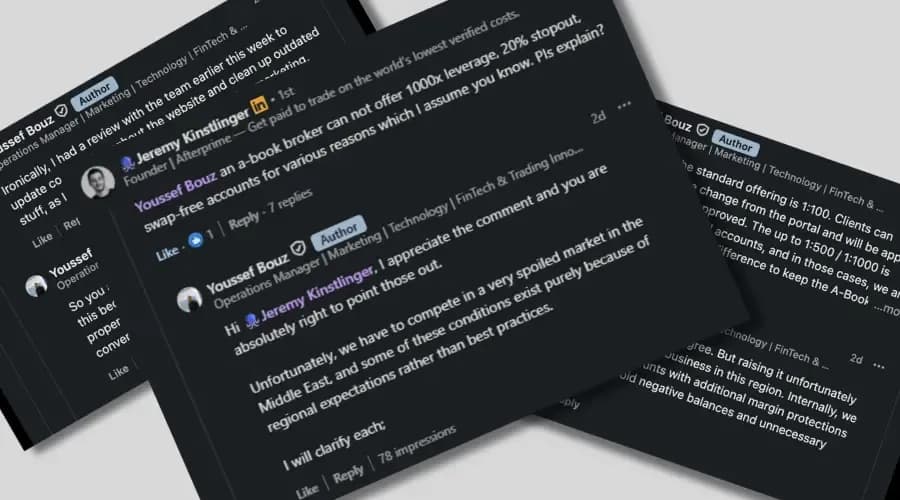
Competing in a Spoiled Market: The Reality of Running a True A-Book Brokerage in an Industry Built on Illusions
November 23, 2025
Exécution, Infrastructure et ce qui compte vraiment pour les traders algorithmiques
Dans la partie 4 de sa série A-Book STP, Youssef Bouz explique pourquoi la qualité d'exécution et l'infrastructure — et non la vitesse brute — animent la performance des traders algorithmiques, et comment la cohérence, la stabilité des VPS et la latence prévisible distinguent les véritables environnements de trading des promesses marketing.
Invalid Date